
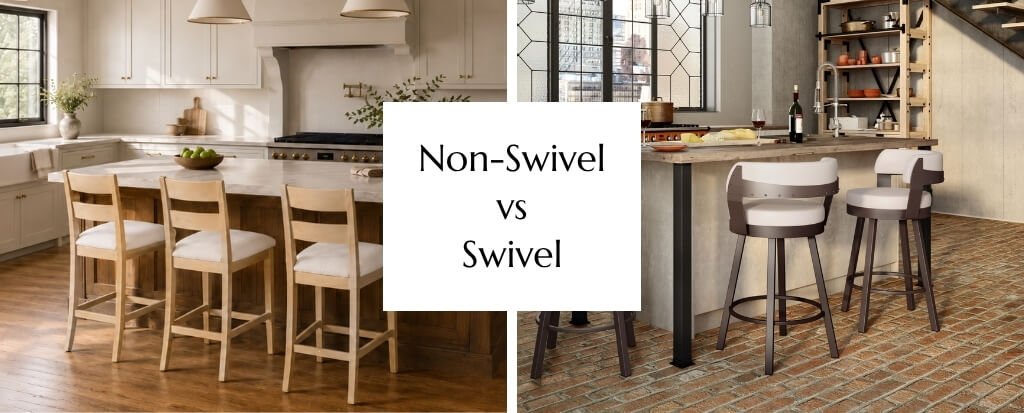
Summary Choose a non-swivel bar stool if you want the stools to stay neatly positioned, protect the counter from rotating backs, and have fewer moving parts. Choose a swivel bar stool if you want easier movement, easier access in and out, and the ability to turn toward other areas of the room while seated.
Before you shop for bar stools, one of the first decisions you’ll need to make is whether you want a non-swivel stool or a swivel stool.
Both have their advantages. The better choice usually comes down to where the stools will be used, who’s using them, how much space you have, and how much movement you want at your counter or kitchen island.
Let’s look at the pros and cons of each.
Non-Swivel, Stationary, or Fixed-Seat Bar Stools
These types of stools go by several names. You may see them called non-swivel, stationary, or fixed-seat bar stools. Sometimes the word “non-swivel” won’t appear in the product name at all.
The important thing is that the seat doesn’t rotate. When you’re sitting on the stool, you can’t swivel to the left or right. When you get up, the seat and back stay in the same position.
Pros of Non-Swivel Bar Stools
PRO: They stay looking neat and orderly.
If you like your stools lined up evenly along your kitchen island, stationary stools make that easy. The backs stay centered instead of ending up turned at different angles after people get up.
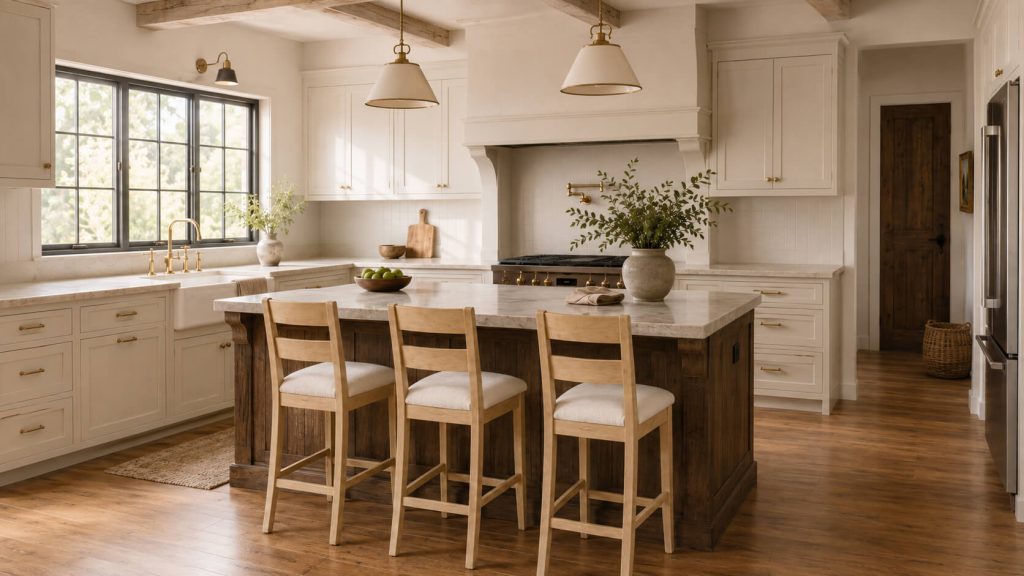
PRO: They’re less likely to hit your counter.
If the stool has a back, a stationary seat keeps that backrest facing the same direction. You don’t have to worry about someone spinning around and repeatedly knocking the back into the edge of your counter or island.
This can be especially helpful if you have painted cabinetry, woodwork, or another surface you want to protect.
PRO: There are fewer moving parts.
A non-swivel stool doesn’t need a swivel mechanism. That’s one less mechanical component that can loosen, squeak, wear out, or eventually need to be replaced.
PRO: They can be a better option for kids who love to spin.
Some kids can’t resist turning a swivel stool into a ride. If you have children who constantly spin, push off the counter, or bang the stool back into the island, stationary seating may save you some frustration.
PRO: The seat can feel more stable.
Some people simply prefer a seat that doesn’t move beneath them. This may be especially appealing to someone who feels less comfortable sitting on a rotating seat.
PRO: They can work well in tighter spaces.
Because the seat isn’t rotating, you don’t have to worry about the back swinging into a wall, cabinet, another stool, or nearby furniture.
PRO: They tend to be quieter.
There’s no swivel mechanism moving underneath the seat, which means there’s one less source of squeaking or mechanical noise.
Cons of Non-Swivel Bar Stools
CON: You can’t easily turn while you’re seated.
If you’re sitting at your kitchen island and want to turn around to talk to someone behind you, watch TV, or face another part of the room, you’ll have to turn your body or move the entire stool.
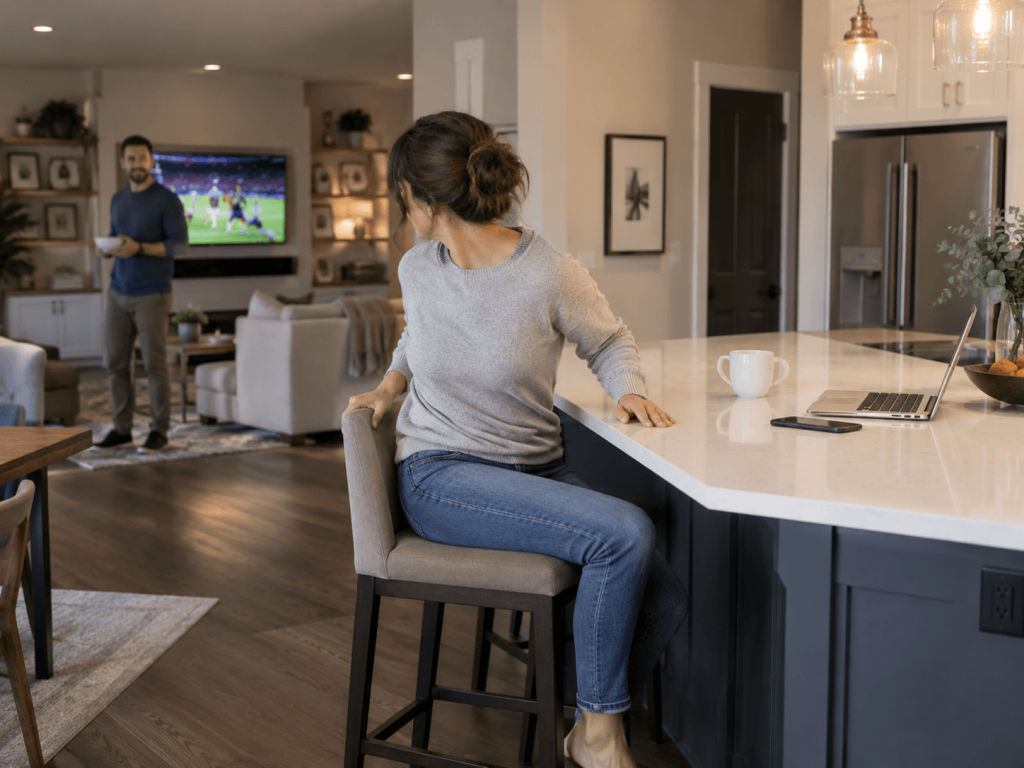
This can become noticeable in open-concept kitchens where the island faces the kitchen, but the living room is behind it.
CON: You may have to pull the stool away from the counter to sit down.
With a stationary stool, people often pull or slide the entire stool backward before getting into it.
That may not sound like a big issue, but it’s something you’ll do every day.
CON: The stool may get dragged across the floor more often.
Because you can’t simply rotate the seat to get in and out, stationary stools are more likely to be moved.
Good floor glides are especially important if you have hardwood, luxury vinyl, tile, or another flooring surface you want to protect.
CON: You’ll want enough room behind the stool.
If you need to pull the stool backward before sitting down, make sure there is enough walkway space behind it.
CON: They may be less convenient for someone with limited mobility.
A stationary stool can feel very stable once you’re sitting on it, which some people prefer.
However, someone who has difficulty maneuvering may find a swivel stool easier because the seat can be turned outward before sitting down and then rotated toward the counter.
Swivel Bar Stools
Swivel bar stools have a seat that rotates independently from the base of the stool.
They are especially popular at kitchen islands, home bars, game rooms, and open-concept spaces because they allow you to turn without moving the entire stool.
There are two main types you’ll commonly see: 360-degree swivel stools and 180-degree memory-return swivel stools.
Pros of Swivel Bar Stools
PRO: You can turn toward different areas of the room.
This is particularly useful in an open-concept home.
You can sit at the island while eating, then turn around to talk to someone in the living room or watch TV without dragging the stool across the floor.
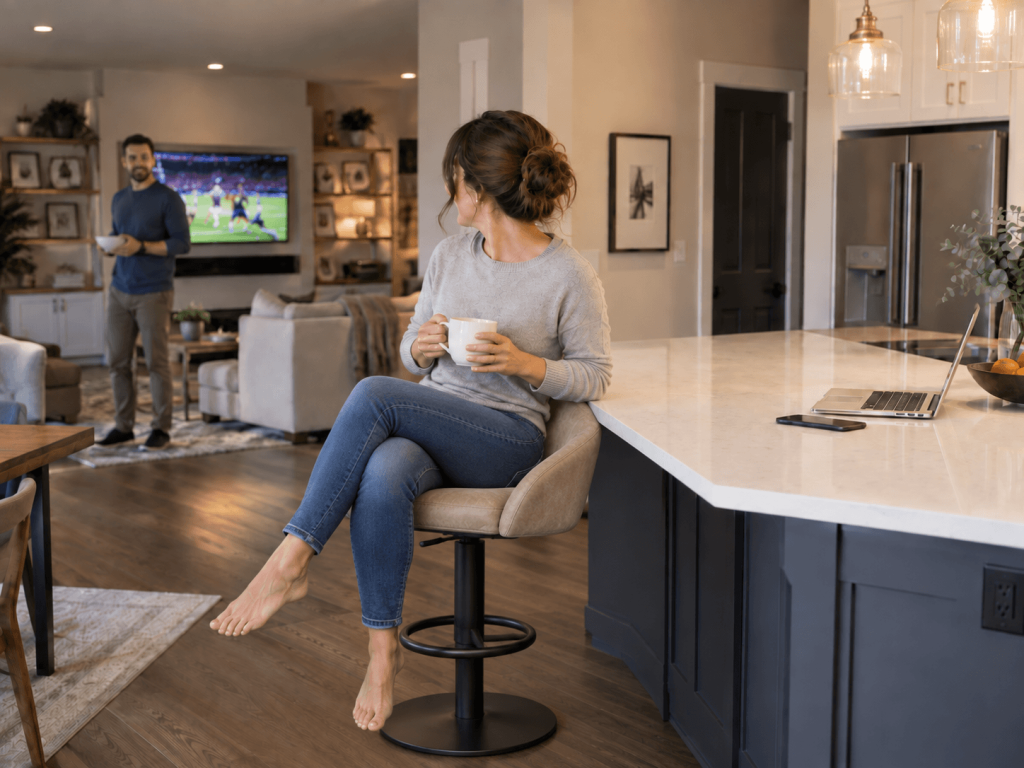
PRO: They’re easier to get into and out of.
Instead of pulling the entire stool away from the counter, you can rotate the seat outward, sit down, and turn yourself back toward the counter.
For many people, this is one of the biggest reasons to choose a swivel.
PRO: There’s less need to move the entire stool.
Since the seat rotates, the base can remain in place more often.
That may mean less dragging across hardwood or tile and less lifting of a heavy stool.
PRO: They can be more convenient for entertaining.
At a kitchen island or home bar, people naturally turn toward whoever they’re talking to. A swivel lets them do that without repositioning the whole stool.
PRO: They can be easier for some people with mobility concerns.
Being able to turn the seat before sitting or standing may make getting into a stool easier for some people.
That said, someone who wants a completely stationary seat may feel more secure on a non-swivel stool, so this really depends on the individual.
Cons of Swivel Bar Stools
CON: The back can hit the counter.
This is probably the biggest drawback of a swivel stool with a back.
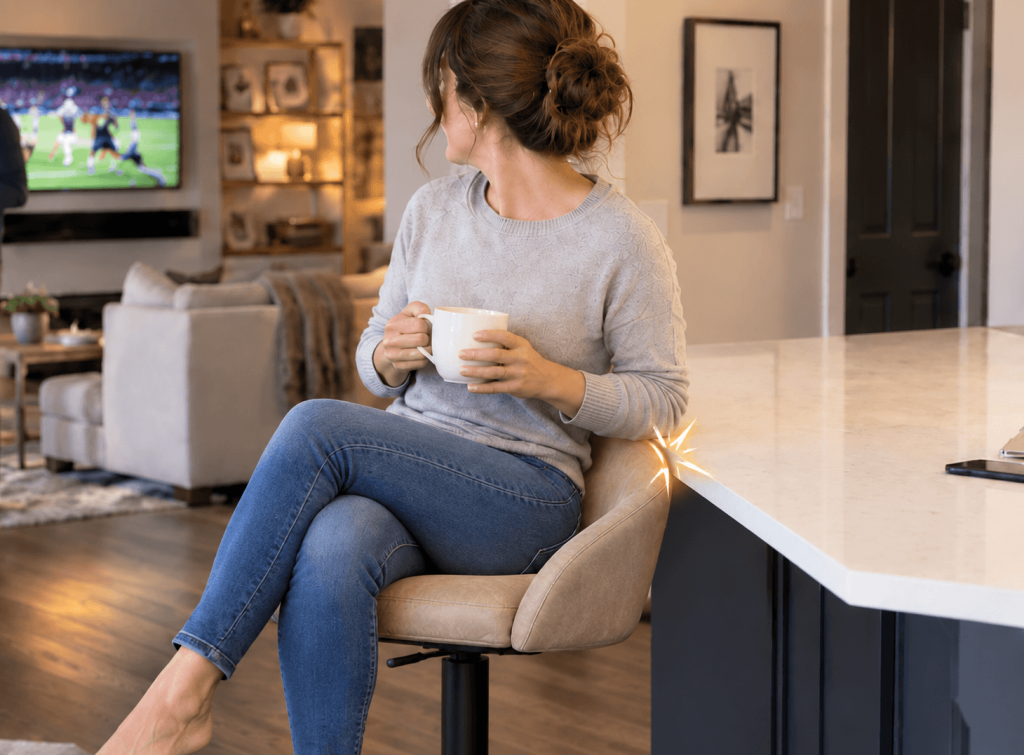
Someone can turn the seat and bump the backrest into the edge of the counter or island. Over time, repeated contact can mark the stool, the counter, or both.
CON: The stools may not stay perfectly lined up.
With a traditional 360-degree swivel, the seats can be left facing different directions.
If you’re someone who likes all of your stools perfectly centered under the island, you may find yourself straightening them.
CON: There are more moving parts.
A swivel mechanism is another component of the stool. On a quality stool, that mechanism can last for many years, but it is still a part that may eventually loosen or need replacement.
CON: Kids may spin on them.
For children, a swivel stool can sometimes become entertainment instead of seating.
Constant spinning or pushing off the counter may also put unnecessary wear on the stool.
CON: Cheap swivel mechanisms can develop problems.
After selling swivel bar stools for years, we’ve found that the quality of the swivel mechanism makes a noticeable difference. Lower-quality mechanisms can become noisy, loose, or wobbly over time.
At Barstool Comforts, we focus on high-quality swivel mechanisms designed for long-term use, and many are backed by manufacturer warranties.
360-Degree Swivel vs. 180-Degree Memory-Return Swivel
A 360-degree swivel offers the most freedom of movement and is generally more comfortable because the seat turns freely in either direction.
A 180-degree memory-return swivel turns left or right, then springs back to center. This keeps stools looking neat, but you may feel resistance while turned to the side.
One thing to watch for: when a memory-return swivel snaps back to center, the stool back can sometimes hit the counter depending on its position.
So, Should You Choose Swivel or Non-Swivel Bar Stools?
Choose a non-swivel bar stool if:
- You want your stools to stay neatly lined up.
- You’re concerned about the backrest hitting your counter.
- You prefer fewer moving parts.
- You want a seat that feels completely stationary.
- You have kids who are likely to constantly spin.
- Your stools are going into a tighter space where rotating backs could hit nearby surfaces.
Choose a swivel bar stool if:
- You want to turn toward different areas of the room while seated.
- You have an open-concept kitchen or living area.
- You don’t want to constantly pull your stools away from the counter.
- You want easier access when getting in and out of the stool.
- You entertain often and want guests to be able to turn toward conversations.
- Convenience and movement matter more to you than having every stool perfectly lined up.
| Swivel Bar Stools | Non-Swivel Bar Stools | |
|---|---|---|
| Easy to turn | Yes | No |
| Easy to get in and out of | Better | Requires moving the stool more |
| Protects the counter | Back can hit the counter | Better |
| Stays lined up | Not always | Yes |
| Moving parts | More | Fewer |
| Best for open-concept spaces | Yes | Depends |
| Kids who like to spin | Can be a concern | Better choice |
There’s no universal winner between swivel and non-swivel bar stools. The right choice depends on how you use your kitchen island, counter, or home bar every day.
At Barstool Comforts, we carry both styles in a wide range of heights, materials, finishes, and upholstery options, so you can choose the type that works best for your space and how you like to sit.
Ready to shop? Browse our non-swivel bar stools or swivel bar stools to find the right fit for your home.